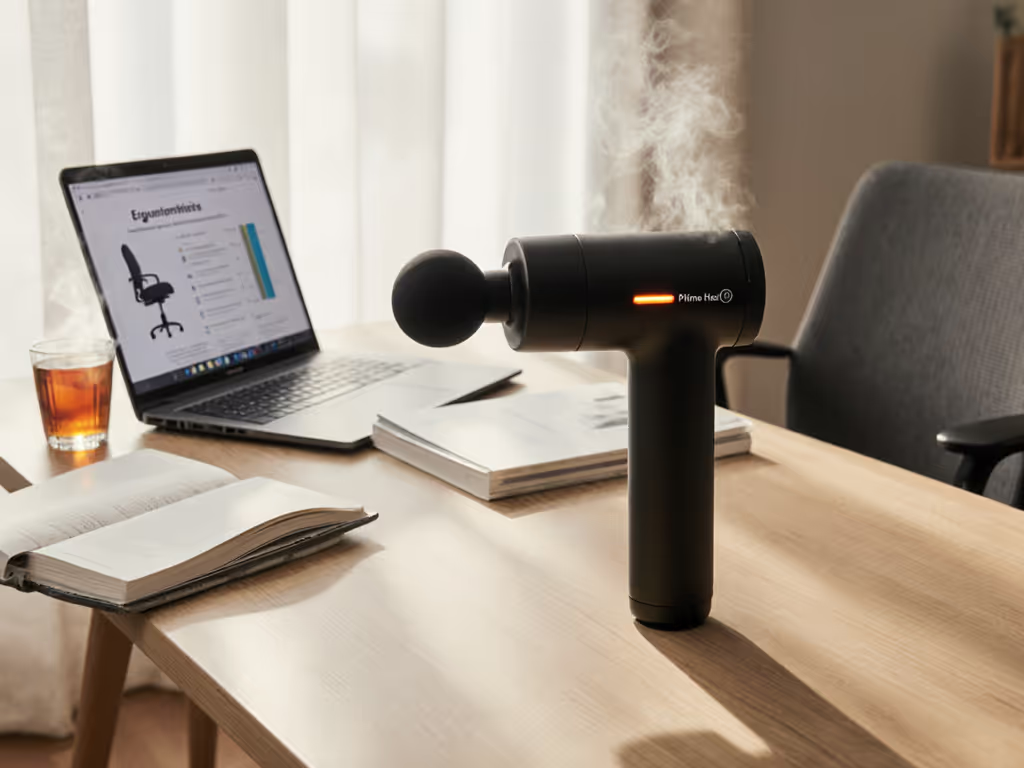

Thera360 Plus Rotating Head: Hype vs Performance
By Kira Volkov • 2nd May
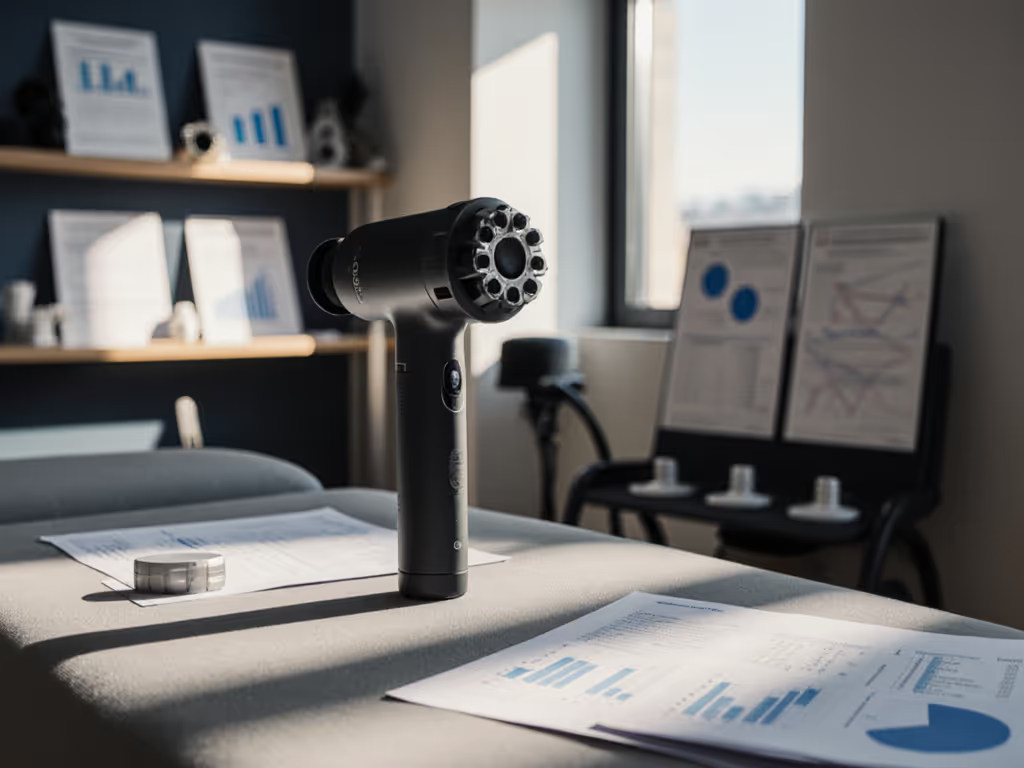
The Problem: Everyone Wants a Rotating Head
Marketing departments have latched onto 360-degree massage technology and rotating head designs like they're the next big thing. The pitch is seductive: a head that moves, spins, or rotates will somehow reach more muscle, deliver deeper work, and make recovery easier. Meanwhile, athletes and desk workers drowning in options - amplitude specs, stall force numbers, percussive frequencies - end up paralyzed by choice.
The real issue isn't the rotating head. It's that most people buying recovery tools don't know what actually moves the needle for their grip strength, tissue access, or recovery speed. If you're unsure which specs actually matter, start with our massage gun buying guide.
The Agitate: What Rotating Heads Promise vs. What Actually Matters
Here's where I get direct: Grip, reach, and torque decide whether power actually returns. For hand fit and handle design, see our massage gun ergonomics guide.
When I'm testing a recovery tool, I'm not looking at how many directions the head claims to move. I'm looking at three non-negotiable metrics:
- Stall force: How much actual pressure can the motor deliver before it bogs down and the head stops moving?
- Reach: Can I solo access my mid-back, lats, and glutes without twisted arms or awkward angles?
- Grip texture and handle length: Will my hand stay confident at minute eight, or will I be white-knuckling it by minute five?
The rotating head narrative sounds premium. But a rotating head attached to a weak motor, a short stubby handle, and a glossy grip that slides under sweat pressure is just a heavier, more complex version of a bad tool.
The Meet Week Reality Check
During a particularly brutal competition week, I was blasting my traps between attempts with a lightweight rotating head massage gun. Sounded good in theory. The head stalled the moment I pressed into the tightest knots. I swapped to a grippier handle with higher stall force - no rotating tech, just solid mechanics - and suddenly the lockout felt cleaner without burning through warm-up sets. The simpler tool survived the pressure. The rotating one failed.
If it fails under pressure, it fails your program.
Why Rotating Heads Add Complexity Without Added Payoff
Most rotating-head designs add weight, moving joints, and mechanical complexity. The motor has to fight inertia, spinning a head that's now heavier and less direct. That's energy that could've gone into percussive depth and stall force sustainability.
A traditional fixed head - if it has higher stall force, a better grip, and longer reach - often outworks a rotating head in real-world use. Real-world meaning: a solo athlete or desk warrior trying to address glute soreness or upper-trap tension in under ten minutes, not in a clinical setting with perfect conditions.
The Market Positioning Around Rotating Technology
Therasage and similar brands have positioned rotating-head units as the next evolution in recovery. Before you buy the "next evolution," read our massage gun marketing scams reality check. Portable, promoted as comprehensive. Here's what matters before you commit cash: Does the rotating head actually increase percussive amplitude, or is it marketing gloss? Is the motor's stall force higher than a non-rotating competitor? Does the handle length and grip texture survive 8-10 minute sessions on large muscle groups?
The rotating head component alone is not a performance differentiator. It's a feature detail. The engine matters. The reach matters. The grip texture matters. The silence of operation matters. Rotation? Secondary.
The Solve: Metrics That Actually Determine Recovery Tool Efficacy
Stall Force: The Non-Negotiable First Filter
Stall force - measured in pounds of force (lbf) - tells you whether the motor can maintain percussive depth on dense tissue. A weak motor stalls the moment you press into a knot. A strong one holds frequency and amplitude even at high resistance.
Most commercial rotating-head units quote stall force between 15-30 lbf. See how brushless vs brushed motors impact real stall force, noise, and durability. Non-rotating competitors often sit in the same range or higher. The difference isn't the head design; it's the motor architecture and power delivery efficiency.
Real-world stall force test:
- Load the massage gun at medium pressure (not light, not maximum) into a resistance band or dense foam block.
- Count how many seconds the motor maintains that percussive rate before audible drop-off or slowdown.
- If it stalls in under 20 seconds under sustained pressure, reach fatigue will be high during actual use.
Reach and Handle Length: Access Decides Adherence
A 6-inch handle is not the same as an 8-inch handle when you're solo-addressing your own glutes, mid-back, or hamstrings. Shorter reach means twisted arms, wrist strain, and early dropout from fatigue - not because the motor failed, but because your human anatomy failed first.
The reach checklist:
- Can you access your own mid-back without hyperextending your shoulder?
- Can you reach mid-glute without inverting your wrist or assuming a painful position?
- Can your smaller-handed teammate or partner use the same tool comfortably, or is it too long and unwieldy?
Reach that doesn't work for your body size means the tool gets abandoned within two weeks.
Grip Texture and Interface Architecture
A rotating head adds weight to the handle. A glossy, smooth grip under that weight is a liability. Sweat, vibration, slight tremor fatigue - all of it causes slipping. A textured grip - rubber overmold, slightly aggressive surface - keeps your hand positioned exactly where you need it.
Why this compounds: If your grip fails at minute six, you stop, reposition, and lose session continuity. That friction cost multiplies across a week of use. You'll unconsciously avoid the tool because it's annoying to hold.
Cadence and Percussive Rhythm: Therapeutic vs. Jarring
A rotating head might distribute impact more evenly across tissue. In theory. In practice, most athletes care whether the cadence - usually 30-50 Hz for commercial units - feels therapeutic, not painful. Jarring, prickly percussion is not therapeutic. A smoother, more natural rhythm (even at the same frequency) drives longer exposure and actual adherence.
Rotating vs. fixed is irrelevant if the rhythm doesn't match your tissue tolerance.
Noise and the Travel Factor
A quiet tool gets used. A loud tool gets used less, especially in shared spaces - offices, hotels, apartments with thin walls. Rotating heads, if they're heavier and have more moving parts, are often slightly louder. That's a hidden cost for the road-warrior or deskworker who wants early-morning use without waking a partner. Prefer stealth? We tested the quietest massage guns for offices and hotels.
The Verdict: Rotating Head Technology in Real Practice
What Rotating Heads Actually Deliver
- Slightly broader tissue contact surface: If optimized, a rotating or multi-directional head can cover more square inches with each percussive cycle.
- Marketing differentiation: They're novel, they sound advanced, and that perception carries sales value.
- Potential for gentler, more distributed pressure: In theory, rotation can reduce user fatigue on very sensitive tissues or bony areas.
What They Don't Reliably Deliver
- Higher stall force (usually comparable to fixed-head competitors in the same price tier)
- Deeper percussive penetration (often undermined by added motor complexity and weight)
- Significantly better muscle recovery outcomes (recovery depends on frequency, amplitude, duration, and tissue tolerance - not on how many directions the head moves)
- Reduced wrist strain (often increased due to handle weight and leverage geometry)
- Superior comfort for solo large-muscle-group work
When a Rotating Head Might Make Legitimate Sense
- Post-injury or hyperresponsive tissue: If you're recovering from a soft-tissue injury or working on very sensitive areas (calves, shin splints), the distributed contact might feel less aggressive than a concentrated fixed head.
- You've tested side-by-side and felt a difference: If you've held both units and genuinely noticed superior comfort or tissue response, the rotating design worked for your body.
- You prioritize psychology and perception: If the perception of advanced technology increases your actual adherence and you use it consistently, the placebo effect is real and measurable in reduced DOMS.
When to Skip Rotating Head Technology
- You're targeting large muscle groups: Quads, glutes, back DOMS - you need amplitude and sustained stall force, not distributed rotation. Depth beats breadth here.
- You're on a budget: Rotating-head mechanisms add cost. That money is better spent on a fixed-head tool with superior motor specs, longer reach, and textured grip.
- You travel frequently: Rotating heads add weight and moving parts; TSA-friendly battery, USB-C charging, and durability matter far more.
- You value simplicity and silence: Fewer moving parts = fewer failure points, lower noise, less maintenance friction.
Final Verdict: The Rotating Head Review
The Thera360 Plus review inquiry and broader rotating-head massage gun trend ultimately ask one question: Is rotating-head technology hype or legitimate performance advancement? Here's the clear-eyed answer: it's incremental marketing around existing percussion principles.
A rotating head does not replace a solid motor, a textured grip, an accessible handle length, and genuine stall force. If you're comparing a rotating-head unit to a fixed-head competitor and the rotating one has weaker stall force, a shorter handle, or a slippery grip, the rotation is a liability, not a feature.
Choose a recovery device on the basis of:
- Stall force sustained under load (15+ lbf for dense tissue)
- Handle reach (7-8 inches minimum for solo access to mid-back and glutes)
- Grip texture (textured, not glossy; confidence at minute eight)
- Noise level (under 75 dB for daily use in shared spaces)
- Cadence and rhythm (40-50 Hz; does it feel therapeutic to your tissue, not harsh?)
- Weight and balance (under 2.5 lbs; wrist fatigue is a dropout driver)
Skip the rotating head unless you've tested both options back-to-back and felt a meaningful difference in comfort or tissue response, the rotating model has superior stall force and reach, or you're specifically managing post-injury sensitivity.
Grip, reach, and torque decide. Whether the head rotates is secondary.
The athlete or deskworker who picks a tool based on real metrics - not rotating novelty - will use it consistently, see tangible relief within a week, and integrate it into their daily routine. The one who buys the flashier rotating option with mediocre stall force, poor grip, or short reach will shelve it within two weeks and call it another abandoned recovery gadget.
Test the metrics. Ignore the marketing spin. Your future self will thank you.
Related Articles