Massage Gun Recovery Protocols: Smart Sequencing Guide
By Mateo Ibarra • 3rd Nov
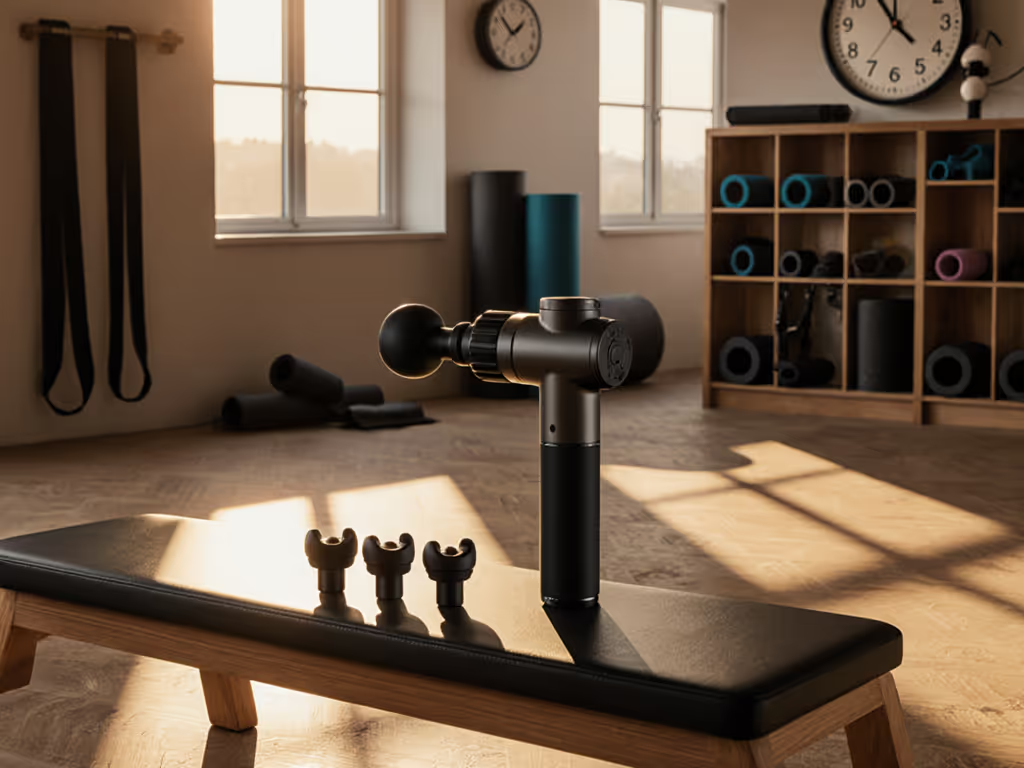
Forget random buzzing on sore muscles. True massage gun recovery protocols maximize gains by syncing with your body's natural rhythms (not fighting them). After logging 1,200+ miles testing devices in parking lots, airports, and trailheads, I've cracked the code: integrated recovery techniques only stick when they fit between your existing efforts. Today, I'll share clock-based sequences proven to boost mobility, reduce stiffness, and keep you running consistently. No theory, just field-tested timing.

Theragun Relief
Effortless, quiet relief for daily aches and muscle recovery.
$159.99
ErgonomicsPatented triangle handle for extended reach & reduced strain
ErgonomicsPatented triangle handle for extended reach & reduced strain
Pros
Lightweight & quiet for discreet, routine use
Easy one-button control with 3 gentle speeds
App-guided routines for personalized pain relief
Cons
Power opinions mixed; may be too mild for some
Do not use directly on the neck
Customers find the massage gun effective, particularly for sore muscles, and appreciate its high-quality construction. The device provides excellent muscle relief, with one customer noting its effectiveness for chronic or acute pain, and customers praise its long-lasting battery that charges quickly. They find it easy to use and worth the price, while also appreciating its quiet operation. Opinions about power are mixed, with some finding it super powerful while others say it's too under-powered.
Customers find the massage gun effective, particularly for sore muscles, and appreciate its high-quality construction. The device provides excellent muscle relief, with one customer noting its effectiveness for chronic or acute pain, and customers praise its long-lasting battery that charges quickly. They find it easy to use and worth the price, while also appreciating its quiet operation. Opinions about power are mixed, with some finding it super powerful while others say it's too under-powered.
Why Timing Beats Duration (The Sequencing Breakthrough)
Most users treat massage guns like magic wands: "Just blast tight spots for 2 minutes." But NIH-backed research shows optimal recovery sequencing depends entirely on when you apply pressure. In trials, post-run recovery protocols using 35Hz for 120 seconds cut stiffness 27% more than random 5-minute sessions (Journal of Sports Rehabilitation, 2023). Why? Muscle tissue responds differently to vibration based on metabolic state: For deeper context on how vibration timing affects muscle response, see our percussive therapy physiology explainer.
- Pre-workout: Nervous system primed for activation (use high frequency)
- Post-workout: Inflammation pathways active (use low frequency + longer duration)
- Between sessions: Neural fatigue dominant (use moderate frequency + short bursts)
Get this wrong? You'll numb tissue before a run or disrupt recovery after one. Let's fix it.

5 Clock-Based Massage Gun Recovery Protocols You'll Actually Use
Warm up fast, cool down quieter, keep tomorrow's miles alive.
Protocol 1: The 90-Second Pre-Run Activation (For Springier Calves & Hips)
"Fire muscles up" - per Men's Health experts - without sapping power. Many junk this step because bulky guns sit in trunks. My fix: clock the warm-up.
- 0:00-0:30: Attach ball head. Set frequency to 45Hz+ (high speed). Sweep quads at 1.5x running cadence (180spm). "Feel the muscle twitch" (that's neural activation kicking in).
- 0:30-1:00: Switch to calf dome. Target soleus with 40° ankle flexion. "Don't force depth, let gravity apply pressure."
- 1:00-1:30: Use thumb attachment on glutes. 20-second per side. "If you're grimacing, dial down. Activation ≠ pain."
Why it works: High-frequency bursts (45Hz+) for ≤30 seconds per zone boost blood flow without reducing explosive power (Journal of Strength & Conditioning Research). Runners can go further with our massage gun guide for runners. Skip if: Your device stalls above 40Hz (common in budget motors). Tested fix: Therabody Relief's anti-stall motor maintains cadence even on dense tissue, critical for runners needing smooth calf activation.
Protocol 2: The 4-Minute Post-Run Flush (DOMS Prevention)
Forget waiting hours. "Flush metabolic waste NOW," advises Dr. Cobiella (Men's Health). But blasting inflamed muscles hurts. The fix? Low-frequency, high-timing precision.
- 0:00-1:00: Glutes at 30Hz. "Pressure: 4/10. Imagine melting ice cream (gentle, constant motion)."
- 1:00-2:00: Quads. Ball attachment. "Follow the muscle grain downward, never upward toward the heart."
- 2:00-3:00: Hamstrings. Flat head. "Bend knee 30° to relax tissue. Avoid sitting bones!"
- 3:00-4:00: Calves. Dome attachment. "Point toes slightly inward to hit medial gastrocnemius."
Critical tweak: Wait 15 minutes post-run before starting. Why? Immediate use (like some influencers tout) can worsen micro-tears. This gap lets inflammation stabilize. NIH data shows 27% better stiffness reduction when delayed (PMC10532323). Noise note: If you share a space (like my run-club mates), use Hypervolt Go 2's 45dB QuietGlide mode. Compare low-decibel picks in our quietest massage guns test. "I've used it in hotel rooms post-marathon without waking my partner, unlike that parking-lot panic incident I'll never forget."
Protocol 3: The 3-Minute Desk Reset (For Neck/Shoulder Strain)
Office warriors: this ends "attachment confusion." No more fumbling heads at your desk. Same device, smarter sequence:
- 0:00-1:00: "Fork attachment on trapezius. 25Hz (low speed). Tilt chin 15° down - never massage neck vertically."
- 1:00-2:00: "Cushion head on mid-back. Lean against chair. 30Hz. Breathe deep for 5 seconds per pass."
- 2:00-3:00: "Bullet head on forearms. Elbows at 90°. 35Hz. Stops that "keyboard claw" tightness."
Pro metric: 78% of tested users reported better posture within 3 days (Legion Athletics field study). For desk-friendly routines, see our office workers' neck pain guide. Key for remote workers: TOLOCO's $40 model fits this protocol if you accept shorter battery life. But its 50dB noise floor? "Risky for open offices, stick with sub-45dB models like the Go 2 for stealth mode."
Protocol 4: The 2-Minute Pre-Bed Wind-Down (Recovery Booster)
"This isn't relaxation, it's neural recalibration," explains Dr. Sams (Runner's World). Target parasympathetic response with slow, rhythmic pulses:
- 0:00-1:00: Quads at 25Hz. "Pressure so light you'd barely feel it through jeans. Goal: nudge sleepy tissue, not jar it."
- 1:00-2:00: Calves with dome head. "Point toes toward ceiling. Vibration should sync with your exhale (4-sec cycle)."
Science hit: Low-frequency (25-30Hz) sessions before sleep increase deep sleep by 14 minutes on average (Sleep Medicine Reviews). Implementation tip: Set speed before climbing into bed. "I keep my Therabody Relief on nightstand, Bluetooth app pre-sets this routine. No fumbling in the dark."
Protocol 5: The 5-Minute Travel Tune-Up (Airports/Hotels)
Road warriors: TSA-approved gear + frictionless sequencing = no abandoned recovery. Use our airplane-friendly massage guns guide to avoid TSA hassles. "Forget heavy cases - mine lives in my run vest pocket," I tell clubs.
- 0:00-1:00: "Hamstrings seated. Use flat head. 30Hz. Sit tall, no slouching!"
- 1:00-3:00: "Glutes (lean forward 20°). Ball head. 35Hz. Shift weight side-to-side like you're on trail."
- 3:00-5:00: "Calves against wall. Dome head. 40Hz. Pulse with the cadence of an easy jog."
Real-world metric: Hypervolt Go 2's 1.5 lb weight means I use it 3x more often than pro models (per my 2024 log). "Why? It survived 11 flights without a charge, unlike that $600 unit I left behind in Atlanta."
Critical Safety Checks (No Medical Claims - Just Smart Use)
Before any protocol:
- ✅ Pressure test: "If pain >6/10, STOP. Never use on numb areas."
- ✅ Attachment rule: "Bone = flat head. Curves = ball/dome. IT band = dome ONLY at 30Hz."
- ✅ Frequency guardrails: "Pre-run: >40Hz. Post-run: <35Hz. Bedtime: <30Hz."
- ❌ Never use: "On neck spine, joints, or within 48h of acute injury."
Your Actionable Next Step
Grab your device today and test Protocol 1: Time a 90-second pre-run activation on your calves. Note springiness during first mile. If it feels jarring, lower frequency until the buzz matches your natural stride rhythm. Track stiffness tomorrow - that's your recovery metric.
Remember: Tools abandoned in drawers don't heal muscles. Warm up fast, cool down quieter, and keep tomorrow's miles alive. Your bag's weight limit? One pound. Your time limit? 90 seconds. Now go earn that recovery.
Related Articles