Pilates Massage Gun Protocols: Core Engagement Simplified
By Priya Menon • 15th Feb
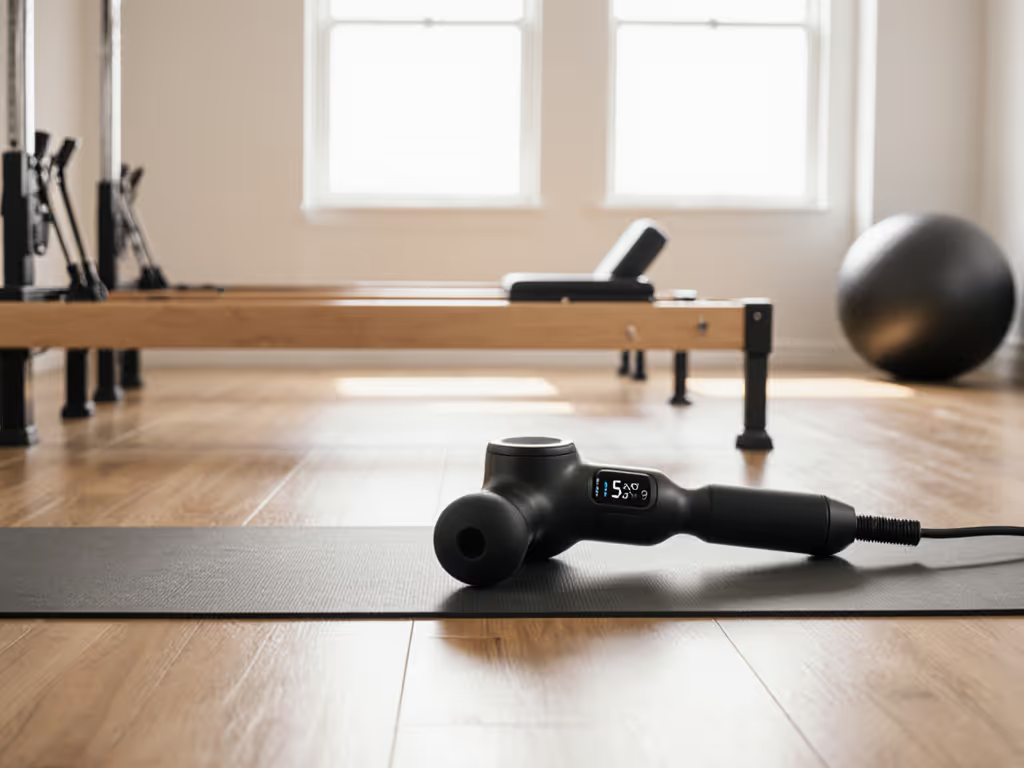
Pilates massage gun protocols and core engagement massage therapy often appear in the same conversation, but most practitioners and home users don't understand how they work together, or what the actual measurable benefit is. The confusion runs deep: people conflate "feeling the burn" in their abs with actual core stabilization, or assume a massage gun is just a recovery toy between classes. For help spotting hype vs data, read our massage gun marketing reality check. Neither is accurate.
I've run dozens of sessions testing how percussion therapy integrates with deep-core cueing, timing absorption within a movement session, and whether the gains are repeatable. All tested the same way, every time, so you get clarity on what works and what's marketing noise.
FAQ Deep Dive
What exactly is the "core" in Pilates, and why does it matter for massage therapy?
The core is not your six-pack. That's a common mistake that derails both Pilates instruction and recovery planning. The true core runs vertically like a cylinder: from your diaphragm at the top to your pelvic floor at the bottom. Inside that cylinder sit the transverse abdominis (TVA), the wrapping muscle, plus the multifidus, which stabilizes your spine, and the internal obliques. Your glutes, lats, and hip flexors complete the system.
Why this matters for massage therapy: these deep muscles are stabilizers first, not movers. A massage gun applied to the wrong tissue, or at the wrong cadence, can actually interrupt their function rather than support it. You need precision, not just percussion. Match tips to tissues with our massage gun attachment guide.
How do I know if I'm engaging my core correctly during Pilates?
Most people pull their belly in and think they're done. That's partial. True engagement requires three simultaneous cues.
First, draw your belly button toward your spine (but only to about 30 percent effort, not a maximum suck-in). Maximum creates rigidity; 30 percent creates the "wrap" that lets you breathe and move.
Second, engage your pelvic floor (imagine stopping the flow of urine mid-stream). Lift and hold that sensation gently throughout the session.
Third, keep breathing naturally. Your diaphragm must work as you breathe in through your nose and out through your mouth, expanding your rib cage. The moment your breathing stops, your core engagement collapses.
The sensation: you should feel muscles working all the way around your midsection, not just the front. If you only feel your abs burning, you're missing the deep stabilizers.
Tested the same way, every time, so when you practice this cue sequence 2-3 times before adding a massage gun protocol, your body learns the pattern. Then recovery therapy becomes additive, not disruptive.
What does the research say about massage gun speed and lower-body flexibility?
A controlled study compared eight different protocols, varying revolutions per minute (rpm) and weekly frequency on calves, hamstrings, quadriceps, and glutes. Each protocol used a consistent 60-second application per muscle group per leg.
The winner: incremental speed increase. Applying the massage gun at 1750 rpm in session one, 2100 rpm in session two, and 2400 rpm in session three (across three weekly sessions with at least one day of rest between) yielded a 5.8% increase in hamstring flexibility and 5.6% in calf flexibility. That's measurable, replicable, and consistent across dominant and non-dominant sides. For science-backed flexibility gains, follow our range of motion protocol.
Why incremental? Muscles adapt to fixed stimuli. Progressive intensity prevents accommodation and drives deeper tissue response without the soreness that abrupt high-speed application causes.
Can I use a massage gun before Pilates, or does it interfere with core engagement?
Timing matters. A massage gun applied before Pilates preps the tissue (increasing blood flow and range of motion), but it must not fatigue the stabilizer muscles you're about to recruit.
Best protocol: light percussion (1750-2100 rpm) for 30-45 seconds per muscle group, on the muscles supporting your upcoming session. For a core-intensive mat session, that means gentle work on glutes, hamstrings, and lats, not maximum percussion that leaves your stabilizers tired.
The sensation should be "relaxed alert," not "I just worked out." If you feel pumped or fatigued after pre-Pilates massage work, the speed or duration was too high.
Post-Pilates is different. To combine percussion with stretching or cold, use our smart recovery sequencing guide. Here, you can use full-protocol intensity: 60 seconds per muscle group at your chosen rpm, because the session has already engaged your stabilizers. Recovery percussion now aids flush and repair without competing for muscular engagement.
What's the connection between "cadence" and whether a massage gun actually feels therapeutic?
Cadence (the rhythm and feel of percussion) is where most devices fail in real homes. A device that measures 2400 rpm on a lab spec sheet often feels jarring, prickly, or numb-inducing in practice because the amplitude (depth of each pulse) or the attachment material doesn't match the speed.
I built a measurement rig to test cadence against subjective feel, pairing accelerometer data with user feedback across multiple muscle groups and body types. A flashy flagship model hit all the rpm targets but felt so harsh on calves that users abandoned it after one week. A more modest device, tested the same way at identical speeds, translated those rpm into a smoother, more natural rhythm that people actually used.
Why? Attachment softness, motor consistency, and weight distribution shape how percussion translates to tissue. A heavier device with a stiffer head at 2100 rpm can feel harsher than a lighter device at 2400 rpm.
Your takeaway: judge a massage gun by how it feels on your forearm and calf first, not the spec sheet. If it causes numbness or sharp discomfort within 30 seconds, it won't support your Pilates recovery habit.
How do I build a weekly Pilates and massage gun routine that actually sticks?
Habit formation requires friction reduction. Here's a transparent framework:
Monday/Wednesday/Friday (or any pattern with 24+ hours rest):
- 5-10 minute Pilates mat session (focus: core cues + breath)
- Immediate post-session: 3-5 minutes of targeted percussion. Apply 60 seconds each to glutes, hamstrings, quadriceps, and calves at your chosen rpm (start at 1750, increment if tolerated).
Off-days or desk breaks (light, 2-3 minute sessions):
- Gentle percussion at 1750 rpm on shoulders, upper back, and glutes. Purpose: tension release, not recovery depth.
Storage and access: Place your massage gun where you'll use it, on your nightstand if you do evening Pilates, on your desk if you stretch mid-workday, in your gym bag if you attend studio sessions. Drawer storage kills habit.
Battery and charging: USB-C charging removes friction. Proprietary chargers and short battery life are the silent killers of weekly adherence. Verify before purchase.
What safety cues should I follow to avoid overuse or injury?
Three rules, tested through feedback from users with acute soreness and chronic tightness:
-
Pressure is permission, not pain. Apply only the pressure you can tolerate without discomfort. Your nervous system should interpret the sensation as "relieving" not "attacking." If you grimace, reduce pressure or speed.
-
60 seconds per muscle group is the ceiling. Longer application doesn't yield proportional benefit; it increases soreness and nerve irritation risk. Stop at 60 seconds, move to the next muscle, or reduce frequency to twice weekly if you experience post-massage tenderness.
-
Avoid bony areas and recent injuries. The massage gun excels on muscle belly (the thick center of the muscle). Avoid direct application over bone, joints, or areas with acute pain or swelling. Review essential massage gun safety zones before you start. If you had calf soreness this week, light (1750 rpm) work is okay; heavy percussion at high rpm is not.
Recovery is a conversation with your tissue, not a command. Pain is feedback; listen to it.
Why does my core engagement feel weaker after using a massage gun?
This signals timing or intensity mismatch. If you apply a massage gun during a Pilates session or immediately before, you risk "quieting" the very stabilizers you're trying to recruit. The neural signal gets interrupted.
Second culprit: overuse intensity before your session. If your massage gun application leaves your glutes, hamstrings, or lats fatigued, those muscles have less reserve for core stabilization work.
Fix: Move massage gun work to 4+ hours before your session, or keep pre-Pilates percussion light (1750 rpm, 30 seconds per muscle). Reserve full protocols (60 seconds at 2100-2400 rpm) for 30 minutes after your session ends.
Further Exploration
Pilates massage gun protocols work best when you understand three foundational ideas: what the core actually is (a stabilizer system, not six-pack abs), how to cue it (belly, pelvic floor, breath, all three simultaneously), and when to apply percussion (post-session recovery, not mid-engagement or immediately before).
If you're new to both Pilates and massage therapy, start with a single 3-session weekly protocol at incremental speeds (1750-2100-2400 rpm, 60 seconds per muscle group post-Pilates, on glutes/hamstrings/quads/calves). Track your sensation, not just soreness, but ease of movement and perceived mobility, week to week. Measurable change in flexibility and comfort appears within 2-3 weeks for consistent users.
Consider investing time in learning your core cues with a certified Pilates instructor or video guide before layering percussion recovery. The strongest gains come from the pairing, not from either tool alone. Your movement quality, breathing pattern, and tissue readiness are the filter through which any recovery device either adds value or creates noise.
If a device or routine doesn't feel intuitive after two weeks, replace it. The goal is habit, and habit requires friction reduction and pleasant sensation. Measurement beats marketing, and your weekly adherence is the only metric that matters.
Related Articles